Buy this book
$19.00
- Instant PDF delivered to your email
- Lifetime access in your Lucid Shelf library
- No DRM · Read anywhere
Mental Health · Men's Wellbeing · Self-Development
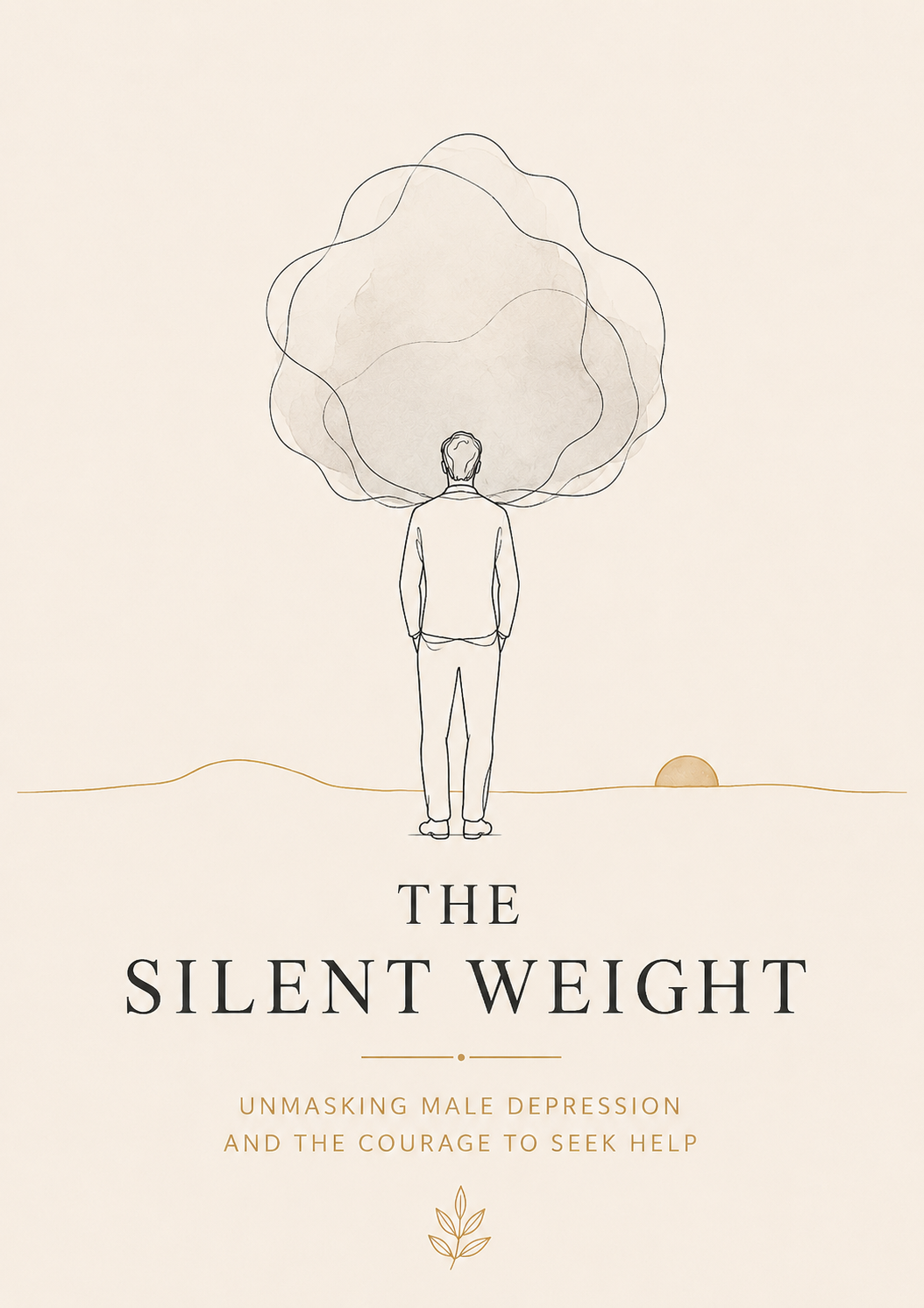
The Silent Weight
Unmasking Male Depression and the Courage to Seek Help
53 pp · 1h read
"You are not weak. You are not broken. You are simply exhausted from fighting a battle that no one else can see."
Read a chapter, on the house
Chapter 1 — The Mask We Wear
There is a specific kind of exhaustion that comes not from physical labor, but from the relentless effort of pretending to be okay. It is a quiet, invisible fatigue that settles deep into the bones, a weight carried by millions of men every single day. If you were to look at them, you would see nothing amiss. You would see fathers coaching little league, professionals leading meetings, friends laughing over a beer, and partners nodding along to evening conversations. But beneath the surface, behind the practiced smiles and the steady voices, there is a profound and isolating struggle. This is the silent weight of male depression, and it almost always begins with a mask.
From a very young age, boys are handed a script. We are taught that strength is synonymous with stoicism, that vulnerability is a liability, and that a man's primary value lies in his ability to provide, protect, and persevere without complaint. When pain arises, the instinct — honed by years of societal conditioning — is to bury it. We learn to construct a facade, a version of ourselves that is capable, unbothered, and endlessly resilient. But this mask, while protective in the short term, eventually becomes a prison. It traps the pain inside, allowing it to fester and grow in the dark, far away from the healing light of connection and understanding.
Consider Mark. At thirty-six, Mark is, by all external measures, a success story. He has a stable career in mid-level management, a marriage that has weathered a decade, and two young children who adore him. His neighbors see a man who mows his lawn on Sunday mornings and waves as they drive by. His colleagues see a reliable team player who never misses a deadline. But what they do not see is the battle Mark fights every morning just to get out of bed.
For Mark, the alarm clock does not signal the start of a new day; it signals the beginning of a performance. When he opens his eyes, he is immediately greeted by a heavy, suffocating fog. It is not a sharp, acute pain, but rather a dull, persistent ache — a profound emptiness that makes the simplest tasks feel like moving mountains. He lies there for a few minutes, staring at the ceiling, gathering the immense energy required to simply exist. Then, he takes a deep breath, forces his features into an expression of mild contentment, and steps out of the bedroom. He makes the coffee, packs the lunches, and kisses his wife goodbye, all while feeling entirely disconnected from the life he is living. He is a ghost haunting his own existence.
During his commute, the silence of his car is deafening. It is the only place where the mask slips, where the sheer exhaustion of holding it all together washes over him. He wonders, often, if he is broken. He wonders why he cannot just be happy, why the life he worked so hard to build feels like a hollow shell. But the moment he pulls into the office parking lot, the mask goes back on. He jokes with his coworkers, he answers emails, he nods in meetings. By the time he returns home, he is so depleted from the effort of pretending that he has nothing left to give his family. He retreats to the couch, scrolling mindlessly on his phone, irritable and distant. His wife asks if he is okay, and he gives the answer he has given a thousand times before: "I'm just tired."
Mark is not just tired. Mark is depressed. But because his experience does not look like the textbook definition of depression, he does not recognize it for what it is.
If you are reading this and recognizing yourself in Mark's story, I want to offer you a moment of grace. I want to validate the immense effort it has taken for you to get out of bed, to go to work, to keep showing up for the people in your life while carrying a mountain on your back. You are not weak. You are not broken. You are simply exhausted from fighting a battle that no one else can see.
The pain you are feeling is real, and the numbness is not a permanent state of being. It is a symptom of a condition that is highly treatable, but the first step toward healing requires doing the very thing you have been taught to fear: acknowledging that the mask exists, and finding the courage to lower it, even just a fraction.
Keep reading
Get the full book + free workbook.
About this book
There is a specific kind of exhaustion that comes not from physical labor, but from the relentless effort of pretending to be okay. The Silent Weight is a compassionate, non-clinical companion for men who are carrying a load no one around them can see — and for the people who love them. Across twenty chapters spanning four parts, it names the mask, dismantles the myths ("Big Boys Don't Cry", the Provider Trap, the Anger Mask), examines the physical and relational toll, and then walks — slowly — toward a real recovery: the courage to be vulnerable, how to ask for help, a practical toolkit, and post-traumatic growth. This is not another checklist for self-optimisation. It is permission to say the two hardest words a man is taught never to say: I'm not fine.
Contents
- Part I — The Invisible BurdenCh. 01
- 1. The Mask We WearCh. 02
- 2. "Big Boys Don't Cry"Ch. 03
- 3. The Provider TrapCh. 04
- 4. The Protector's DilemmaCh. 05
- Part II — How It Shows UpCh. 06
- 5. Burnout to BreakdownCh. 07
- 6. The Anger MaskCh. 08
- 7. The EscapistCh. 09
- 8. Numbing the PainCh. 10
- 9. The Physical TollCh. 11
- 10. The High-Functioning DepressiveCh. 12
- Part III — The CostCh. 13
- 11. The Friendship RecessionCh. 14
- 12. The Financial AbyssCh. 15
- 13. Relationship FracturesCh. 16
- 14. Unprocessed GriefCh. 17
- 15. The Unforgiving MirrorCh. 18
- Part IV — The Way ThroughCh. 19
- 16. The Courage to Be VulnerableCh. 20
- 17. How to Ask for HelpCh. 21
- 18. Supporting the Men We LoveCh. 22
- 19. The Toolkit for RecoveryCh. 23
- 20. Post-Traumatic Growth and HopeCh. 24
Free companion workbook
$19 value.
Yours, free.
Two short PDFs — the Discipline Tracker for weekly reflection, and the Transformation Guide with a real week-by-week example. Designed to be used alongside the book, but useful on their own.